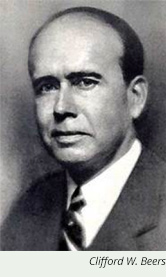
 Thanks to Clifford Beers, the roots of advocacy run deep at MHC.
Although not well known outside of the mental health and addiction world, Clifford Beers is often referred to as the “grandfather of recovery.”
What does that mean?
“Recovery” is inside baseball for those of us in the field, but it has become the primary definition of an approach to care that is the opposite of what was found in psychiatric institutions from the 19th and early 20th centuries. Institutions had a primary goal: to be the home and final resting place for individuals who were deemed “unfit” to society. And, once you were in, it was rare that you would ever get out.
Clifford Beers did not believe that his fate was to live and die in an institution. The inhumane treatment he received and witnessed at psychiatric hospitals was an experience that he promised to share with the world. He left institutions committed to telling the world of his experiences and driven to change minds and the system.
In the early 1900s, Beers was experiencing symptoms of what today may be diagnosed as Bipolar Disorder. After attempting to commit suicide, Beers was subjected to ineffective treatments and cruel conditions in Connecticut’s mental health institutions during three years of hospitalizations. Upon achieving recovery, Beers vowed to make a difference in the mental health system and set out on the task of reform. His autobiography, A Mind That Found Itself, chronicled the harsh and unscientific treatments he had endured and his journey back to health.
Fast forward 111 years from the day he founded MHC (originally as the “CT Society for Mental Hygiene”), I believe Mr. Beers would be smiling and scratching his head at the same time at what he would see in today’s world. The system has changed and there are more community-based programs across the U.S., such as MHCs, than ever. However, our work – and the work of so many caring and smart leaders in this field – is so often hampered by stigma and discrimination, lack of funds, and a deep level of misunderstandings about what mental health is and is not.
Back to our definition of recovery. When those in our field say that someone is “in recovery,” it refers to the approach of care. Recovery comes in all shapes and sizes but it always operates from the same goal of achieving long-term health and wellness v. managing some level of the “you’re stuck with it” mindset that comes from the old psychiatric institutions.
At some point, we’d like to see the word “recovery” disappear altogether. Imagine a world without stigma, where each of us feel safe and comfortable saying, “Something is going on with me that I can’t handle, can you help me?”
When we begin to invest our efforts, time, dollars, and thinking into the work of prevention and the use of effective coping skills, then we will have a world where we can each live our days focused on wellness not illness.
If that’s the case then we are not “recovering” from anything. We are living as the people we were meant to be, with all the good, bad, and ugly that life throws at us with honesty and the support from those around us.
On this Founding Day, we invite you to ask yourself, what is it that I need to be the best version of myself? What would Clifford Beers do?
Thank you for believing in our work, and in yourself. Together, we will make a difference!
-Luis Perez, President and CEO