A small group of friends and neighbors are enjoying a communal picnic along a river. Barbecue grills are ablaze, picnic tables set, and conversation flowing when one member of the group sees a child floating downstream in the rapid river. Immediately, one of the party jumps into the river and rescues the child. No sooner is this child brought to shore, however, when another child is spotted coming down the river, and still another behind it. More people spring into action to rescue the children, only to see still more children on their way down the river, necessitating still more people to join the rescue efforts. One woman, however, responds by running upstream along the shore rather than helping with the rescues. “Where are you going?” ask the others. “We need all the help we can get here.” “I’m going upstream,” she answers, “and see if I can find out how all these children are getting into the river so we can stop the flow of children before we are completely exhausted.”
This story is commonly known as The Upstream Parable. Its exact origin is uncertain, but many date it to the mid 1970’s. There are many variations of the tale. Sometimes the rescuers are churchgoers, sometimes teachers, sometimes doctors. When I have offered it to my clinical psychology students, the rescuers are psychologists (Clever, huh?). The parable, of course, applies to a myriad of problems, and it is certainly relevant to mental health.
Mental health problems, by almost any indicator, seem to be increasing. And they are increasing faster than our ability to provide resources to address them. According to a report from the National Center for Health Workforce Analysis (State of the Behavioral Health Workforce, 2025): “In 2024, approximately 62 million U.S. adults (23% of all U.S. adults) had a mental illness and nearly half of them did not receive treatment (48%)….6 in 10 psychologists do not accept new patients and the national average wait time for behavioral health services is 48 days.” Furthermore, the NCHWA estimates that the discrepancy between needs and resources will steadily increase over the next 10 to 20 years.
Many mental health professionals, then, suggest that we need to go upstream–to identify the sources and contributors to mental health problems and to modify or eliminate those contributors so that fewer people will need treatment. We certainly attempt to do this with medical conditions. Vaccine development, despite the current surge of unfounded concerns, is an excellent example of this. Safe and effective vaccines–from smallpox to polio to measles to COVID—have saved countless lives and prevented millions of potential victims from overwhelming our hospitals and clinics. We have learned about the ways that smoking, alcohol use, poor diet, obesity, and inactivity can contribute to medical problems and have developed interventions to address and reduce those risk factors. Individuals have responded to medical advice by adopting healthier diets, exercising more regularly, and reducing their smoking and drinking to maintain their physical health. It makes sense to do similar things with mental health—to go upstream to reduce toxic elements that are known to undermine mental health, and to strengthen our mental health even if we are not experiencing problems, so that we can better handle challenges that may come and have less need for the limited resources available to treat mental health conditions.
So what sorts of things can be done along those lines? I will focus on one of the things known to contribute significantly to mental health struggles—stress. Are there ways we can reduce the stress to which people are exposed? Are there things people can do to manage situations so that those situations are less stressful and thus less likely to cause mental distress? The answer is a definite yes. I certainly am not suggesting that we can create a stress-free world. But we can reduce stress—by going upstream and addressing the sources of stress. Below are a few examples of current efforts to do so.
A common source of stress, for example, is the workplace environment. Even the most enjoyable jobs can be stressful. But we know ways to make them less so. To reduce wear and tear on employees, some mental health organizations have developed programs to encourage businesses to maintain “healthy” workplaces. The Connecticut Psychological Association, for example, has established the Psychologically Healthy Workplace Program. Its efforts include presentations and workshops describing best practices for creating and sustaining psychological health in the workplace, provision of materials to help accomplish good practices, and awards recognizing (and thereby encouraging) businesses that succeed in providing mentally healthy workplaces. (For more about these programs, see Psychologically Healthy Workplace Program & Awards – Connecticut Psychological Association.) I should note that Mental Health Connecticut also offers presentations and workshops on creating mentally healthy environments (See: Mental Health Workshops – Certified Training & Wellness Programs) and has earned a Workplaces Culture Excellence Award from Energage, a national organization committed to workplace mental health (MHC Wins Top Workplace Award).
Another common source of stress is human relationships. While rewarding relationships can be a joy and a boon to mental health, they are also complicated, messy, challenging, and, yes, often stressful. This is especially true when relationships are not going as well as we would like and when we are not skilled in negotiating such situations. We could (and often do) wait until people are stuck in unsatisfying, or even toxic, relationships, and provide therapy to deal with the sadness, anxiety, anger, and isolation that accompany unsuccessful relationships. Alternatively, we could teach people more effective ways of interacting, sharing feelings, and resolving conflicts—before those conflicts occur — so that therapy won’t be needed. Some upstream advocates have suggested greater availability of instruction for prospective spouses and parents (and have even tossed around the idea that such preparation be required, much like driver training before one gets a license to drive).
Others have attempted to go even more “upstream” and establish positive relationship skills long before adulthood. The Collaborative for Social and Emotional Learning (CASEL) has partnered with schools to train elementary and high school students how to effectively handle human interactions, with a curriculum that involves learning about (and practicing) effective communication, perspective-taking, and conflict-resolution (Advancing Social and Emotional Learning – CASEL). Research results verify that participation in SEL programs leads to improved classroom behavior, increased ability to handle stress and depression, and more positive attitudes of participants toward themselves. CASEL reports also that SEL skills “are positively correlated with higher levels of well-being up to 18 years later.” Participants have a decreased likelihood of living in public housing, receiving public assistance, and having involvement with the police. (https://casel.org/benefits_sel)
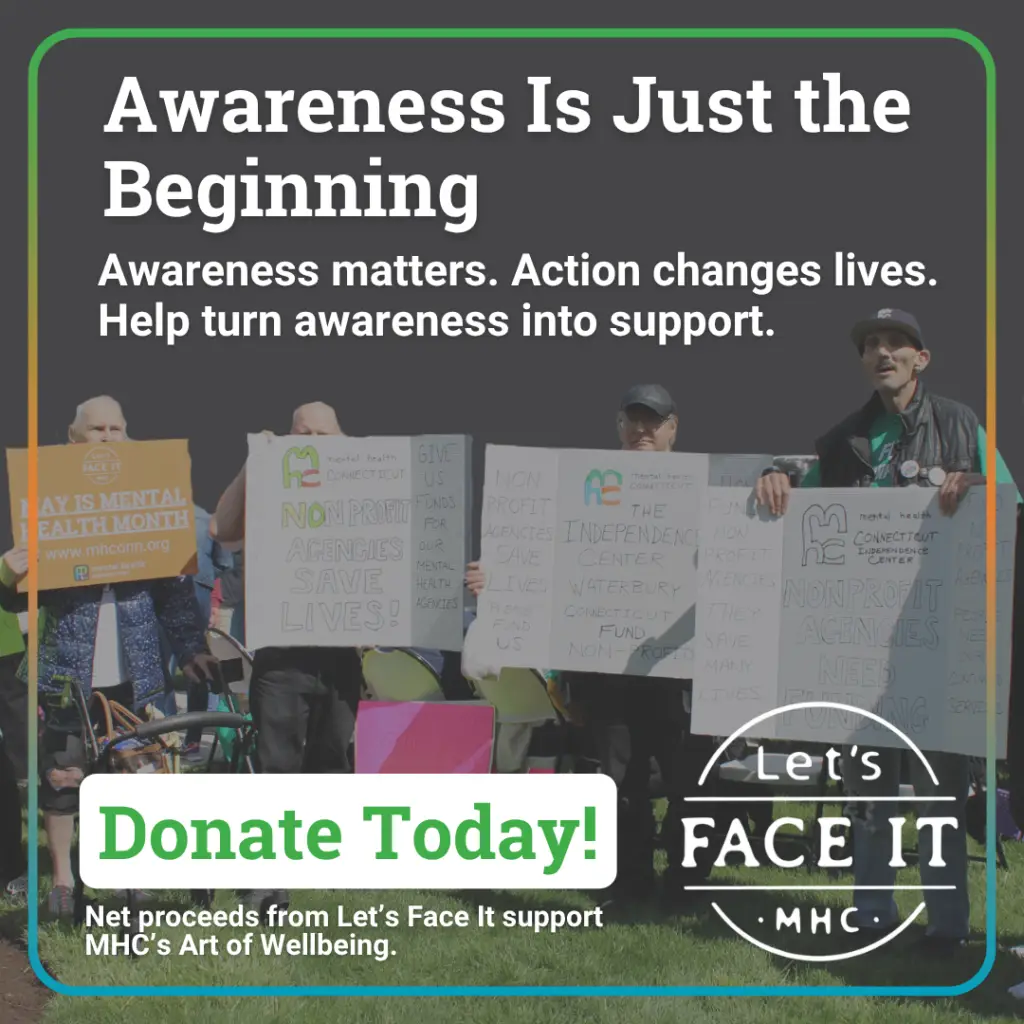
Still another inducer of stress, especially when one might be struggling with mental health, is stigma. (Surely, you didn’t think I could get through a blog without talking about stigma!) As I have discussed before, stigma diminishes people’s willingness to acknowledge mental health problems and to seek help in a timely manner. It damages self-esteem, increases anxiety, and adds to destructive isolation. Again, we can help people to cope with stigma and minimize its damage, OR we can go upstream and try to reduce the stigma that’s out there. Many mental health organizations and agencies try to do just that through public education. This includes Mental Health Connecticut. Its Let’s Face It campaigns during Mental Health Awareness Month (May) present personal stories and host events in order “to spark more conversations and awareness” and “to help create a safer and kinder Connecticut.” (Let’s Face It | Breaking Stigma in Mental Health Awareness Month).
Still other programs go upstream further, to youth audiences, to improve understanding of mental health and reduce stigma. The Institute of Living in Hartford has established The Brain Dance Awards, an annual contest (since 2003) in which high school and middle school students complete and submit art projects focused on mental health challenges, in order to “foster understanding, raise awareness, and cultivate a compassionate and realistic perspective on mental health challenges.” (BrainDance | Institute of Living | Hartford HealthCare | CT).
The national NAMI organization and its affiliates, including NAMI Connecticut, deliver a school-based education program in schools nationwide to promote greater understanding and acceptance of mental health conditions. In the program, Ending the Silence (NAMI Ending the Silence | NAMI), trained presenters follow a standardized curriculum for middle school and high school students. The 50-minute program includes a brief didactic presentation, short videos, and personal testimony from a young person who has experienced mental health difficulties. Research studies (including some of my own) have shown that participation in the program leads to reduced stigma and more positive attitudes about people with mental health challenges.
There are an increasing number of programs that have successfully gone upstream and improved mental health. The ones I have noted are merely examples with which I am familiar. However, these programs are often relatively unknown, underutilized, and underfunded. Moreover, proponents of upstream prevention face a dilemma. As is clear from the data cited earlier in this blog piece, there are already overwhelming numbers of people who are in mental distress (the children in the river, to follow our parable analogy). They need immediate help, and it would be inhumane not to provide it. We cannot simply let the children drown while we travel upstream to prevent future drownings. At the same time, our mental health resources will continue to be overwhelmed—and millions of people will experience preventable distress and life disruption—if we cannot somehow find and repair the upstream forces that undermine mental health and leave us vulnerable to life’s challenges.
In addition, the task of challenging upstream factors can be daunting for an individual. But it is possible to take individual action by helping others be more aware of the need for upstream/prevention work and of the existence of effective programs to accomplish it. One can also support—with donations of time, effort, or money—organizations, like MHC, that take on the challenge. And, given that it is November and I am writing this blog surrounded by political ads, I am reminded that another thing we can do as individuals is vote for candidates more likely to support the kinds of programs I have mentioned, and, maybe even more importantly, tackle the really BIG upstream contributors to mental health problems—war, poverty, discrimination, and economic disparities. Perhaps I will see some of you upstream at the polls.
Otto Wahl, Ph.D.
MHCT Development Committee Member