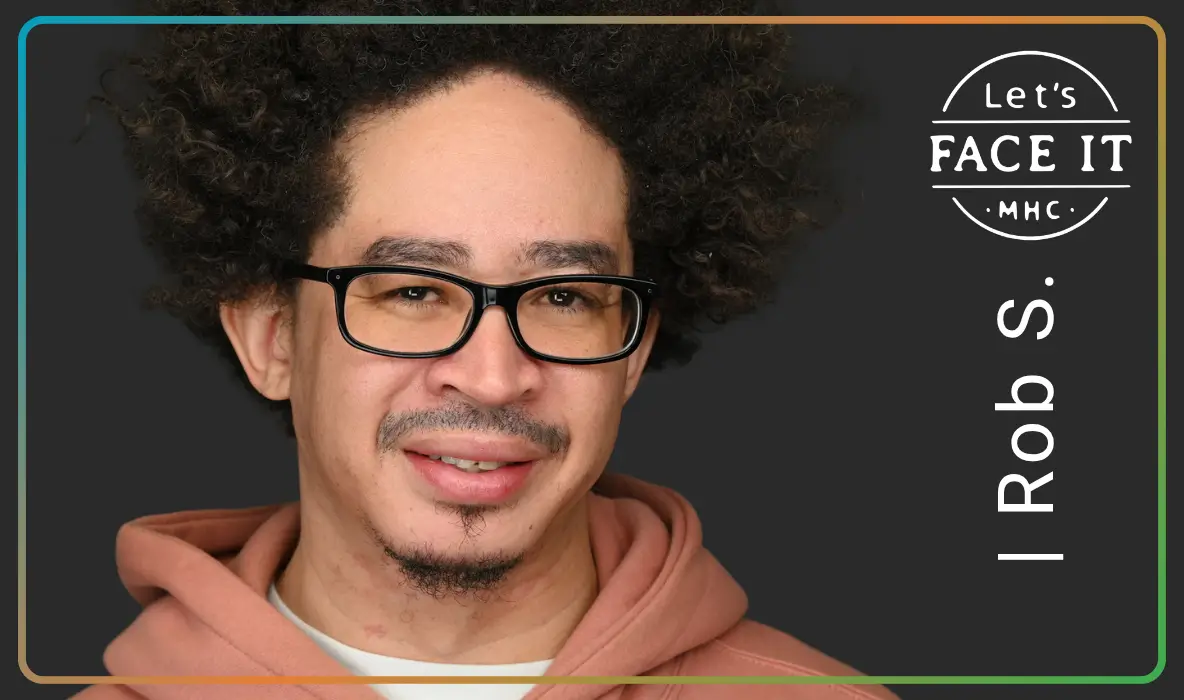
Growing up, Rob knew something felt off but didn’t have the language to describe it or ask for help.
When he was just seven years old, teachers told him he lacked self-control. At home, support didn’t always follow through, and when he tried to talk about what he was experiencing, he was often blamed instead of understood. Rob remembers hating being a kid, hating his body, hating how his mind worked, and wishing things felt different.
“I just wanted whatever it was to stop.”
He spent long stretches, what felt like whole stages of childhood, alone in his room, disconnected and unsure of how to relate to anyone. As a mixed, multi-ethnic man, he also felt like he didn’t fully belong anywhere, “not Black enough” in some spaces, while also navigating constant microaggressions layered onto his mental health in others.
Before it was ever a career, comedy became a way to cope, communicate, and connect.
Watching comedian and actor Richard Pryor changed something for Rob. Pryor spoke openly about pain, his heart attack, and real life, and Rob realized, for the first time, that it was possible to talk about his feelings.
“I hadn’t know that was an option.”
Today, Rob is a father, a teaching artist, a mental health advocate, and a comedian of 18 years. He recently toured his show ADHme at the Warner Theater and other venues across Connecticut, and he is the creator and lead of Beige, a TV series inspired by his own life, following a comedian rebuilding his life after leaving a mental health facility.
His career began in New York City, performing at iconic clubs like Caroline’s, New York Comedy Club, and The Comic Strip, and when he returned to Connecticut, he disrupted the comedy scene with his honest and direct approach. Rob opened his sets with a question: “Is anyone in here crazy?”
Over time, he learned how to get audiences to listen authentically. He doesn’t want to feel safe on stage, and he doesn’t want his audience to feel safe either. For Rob, that discomfort and honesty is what true artistry is.
While comedy offered an outlet, it took years for Rob to fully understand what he was navigating internally. At 33, he was diagnosed with a personality disorder and, shortly after, with ADHD. Awareness of his mental health diagnoses didn’t erase the isolation he had carried since childhood. In many ways, it became sharper.
Dialectical Behavioral Therapy (DBT) was a turning point. Rob describes it as learning “behavioral health math,” a way to break down his thoughts, emotions, and patterns into something he could understand and work through. It gave him tools like radical acceptance and helped him identify his wants and needs and communicate them clearly.
Yet, healing also brought a new challenge. Even when Rob expresses himself directly, it doesn’t mean others know how to receive it. “If I tell somebody exactly what I think and feel, it’s like they don’t know how to handle it.” That gap, between understanding yourself and being understood by others, can feel just as isolating.
“You romanticize healing,” he says, “but no one knows what their healing looks like. It’s not like the end of a game where you win. The next part is, can you deal with the responsibility?”
In many spaces now, Rob is the one people look to. He facilitates workshops, mentors others, offers hope, and helps people make sense of their own experiences. “Sometimes, I get burned out from helping others. I used to utilize support groups, but now, I often find myself leading and supporting others rather than receiving help myself.”
Rob continues to pursue healing and supporting others, yet often finds himself in the familiar place of doing the work, but still carrying much of it on his own.
When Rob reflects on the role stigma has played in his life, his feelings are complex. He’s seen how differently mental health is received depending on who is speaking. In comedy, he watched white men be praised for talking about their mental health; meanwhile, people of color were often met with confusion or judgment.
He believes stigma still exists, but he also believes something is shifting. Part of that shift, for him, is personal. It’s the confidence he’s built to stand in who he is, fully and unapologetically. “This is who I am, and I don’t care what others think of me.”
The other part of the shift is collective activism. “How are we going to stop stigma?” he contemplates. “By stop lowering our voices and start yelling about it.”
You can learn more about Rob’s work here.
———————–
Let’s Face It
Launched in 2022 by Mental Health Connecticut, Let’s Face It takes place every May in celebration of Mental Health Awareness Month. Throughout the month, we host and participate in events, share daily wellness content and vital resources, and spotlight Connecticut residents with lived experiences, amplifying their voices and journeys to inspire hope and understanding.
Why focus on stigma? Because it’s pervasive, taking on various forms, and we firmly believe that its power diminishes when faced head-on. By sharing these compelling stories and daily wellness content, our aim is to spark more conversations, show the individuality of mental health, and increase awareness. Through Let’s Face It, we hope to help create a safer and kinder Connecticut for all.
Let’s Face It 2026 is presented by ConnectiCare. Learn more at mhconn.org.
Story Sponsor